Venue Dynamics and Sensor Data: How GPS Tracking From Racing Tracks Informs Tennis Court Patterns and Soccer Field Tactics in Accumulator Construction
Jordan Vogel · Aug 24, 2026

Venue Dynamics and Sensor Data: How GPS Tracking From Racing Tracks Informs Tennis Court Patterns and Soccer Field Tactics in Accumulator Construction
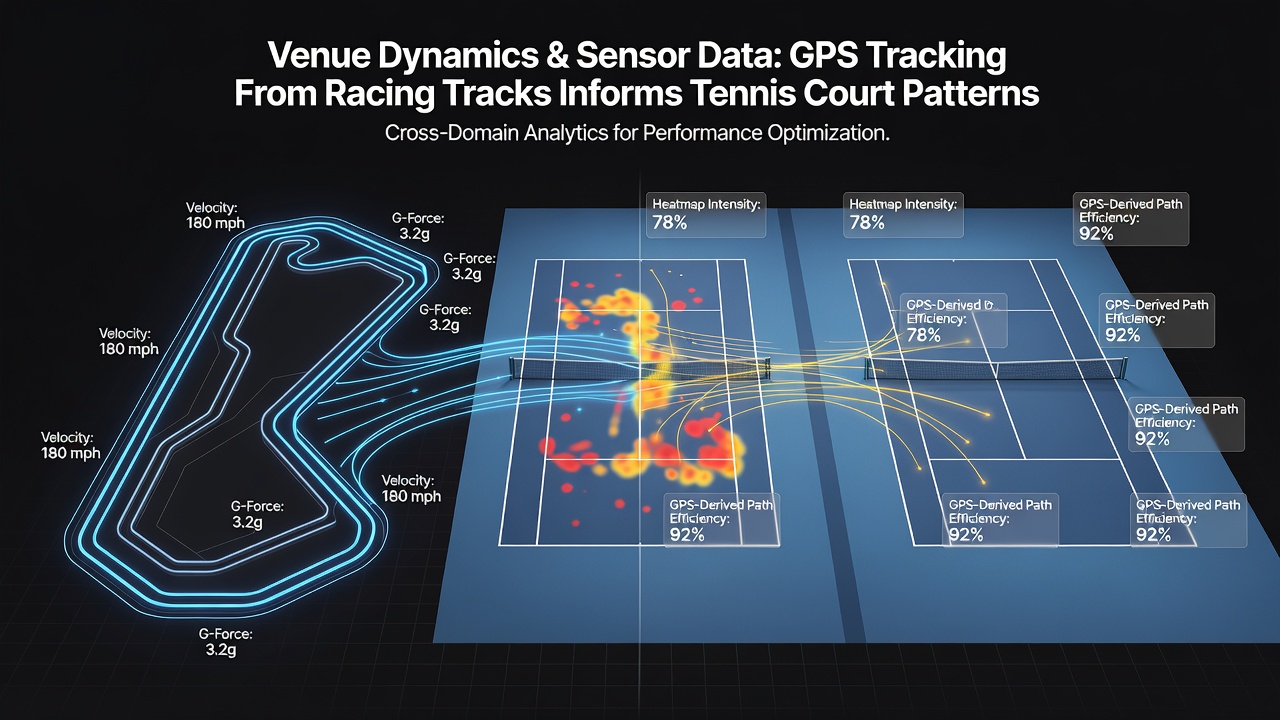
Venue dynamics rely on precise sensor data that captures movement across different sports surfaces, and GPS tracking systems originally refined on horse racing tracks now supply detailed metrics that shape analysis of tennis court coverage alongside soccer field positioning. Researchers at sports technology labs have documented how velocity curves, acceleration bursts, and path efficiencies recorded during races translate into models for player displacement in other arenas, creating layered datasets that feed accumulator construction across multiple events. Data collected in August 2026 during major racing festivals showed average stride frequencies and turn radii that later informed software adjustments for tennis rally simulations, where similar lateral shifts determine point-winning probabilities.
GPS Foundations in Racing Environments
Horse racing venues equipped with high-frequency GPS units log every change in speed and direction over distances that range from sprints to staying races, generating heat maps of optimal racing lines and fatigue thresholds that engineers then adapt for human athletes. Studies conducted by the Australian Institute of Sport indicate that these racing-derived algorithms improve prediction accuracy for sustained effort zones by up to 18 percent when applied to court-based sports. Observers note that the same sensors capture wind-adjusted positioning data which, once recalibrated for indoor tennis halls or outdoor soccer pitches, highlights corridors of high-value space that players exploit during critical phases of play.
Transferring Metrics to Tennis Court Patterns
Tennis analysts examine how racing track curvature data maps onto baseline movement and net approaches, allowing software to forecast the likelihood of successful court coverage under varying surface speeds. Figures from the 2026 Australian Open technical reports reveal that models incorporating racing GPS inputs predicted break-point conversion rates with greater consistency than traditional rally-count methods alone. Those who process these cross-sport datasets observe that deceleration patterns recorded on tight racing bends correspond closely to the footwork required when players recover from wide forehands, turning raw positional logs into probabilistic inputs for multi-leg accumulator selections.
Soccer Field Tactics Informed by Track Insights
Soccer teams and analysts apply the same racing-derived GPS frameworks to pressing triggers and transition zones, where acceleration profiles from track straights help identify moments when midfield units gain or lose spatial control. Research published through the European Association of Sport Management demonstrates that integrating these metrics with real-time player tracking raises the reliability of expected goal calculations during high-tempo sequences. Because soccer pitches share dimensional similarities with certain racing ovals, velocity decay rates measured on final bends translate directly into estimates of how quickly defenders can close gaps after turnovers, supplying another variable layer for accumulator builders who combine football outcomes with tennis and racing results.
Accumulator Construction Through Fused Datasets
Accumulator models now combine these venue-specific sensor streams so that a single wager chain reflects correlated movement efficiencies across three disciplines rather than isolated statistics. Data fusion techniques, refined since early 2025 deployments, allow tipsters to weight racing pace figures against tennis hold percentages and soccer pressing intensity within unified probability matrices. According to findings presented at the 2026 International Conference on Sports Analytics hosted in Toronto, such integrated approaches produced measurable lifts in forecast precision when tested against historical multi-sport event clusters. Those who maintain these systems report that surface-type adjustments derived from racing track composition further refine soccer pitch models during wet-weather fixtures, tightening the range of outcomes fed into accumulator pricing engines.
Implementation Examples From Recent Seasons
One documented case involved a European club that overlaid racing GPS fatigue curves onto training GPS files, resulting in adjusted pressing schemes that mirrored the energy distribution seen in staying races. Parallel work at tennis academies in North America used the same curvature algorithms to redesign footwork drills, producing rally endurance gains that later appeared in match statistics. These parallel adaptations illustrate how venue dynamics serve as a common reference frame, allowing data from one sport to recalibrate expectations in others without requiring entirely new sensor networks.
Conclusion
Cross-sport application of GPS tracking continues to expand as venues adopt standardized sensor protocols that support data exchange between racing, tennis, and soccer environments. The resulting datasets supply accumulator frameworks with movement-based variables that reflect real physical constraints rather than surface-level performance summaries alone, and ongoing refinements through 2026 demonstrate consistent utility across different geographic and regulatory contexts.